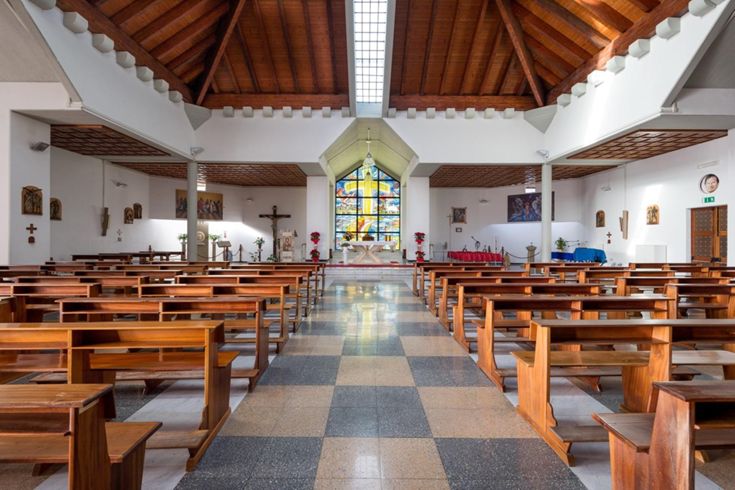
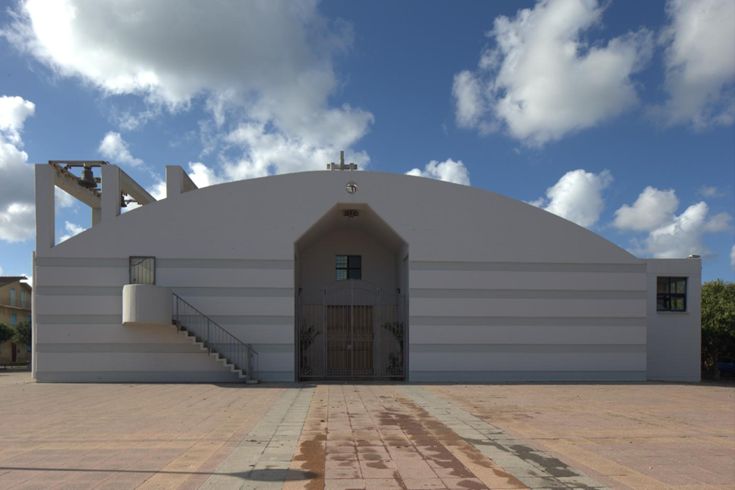
The church of Our Lady of Bonaria, designed by architect Angelo Marongiu in the 1990s, is located at the entrance to Sant'Antioco. Its main façade appears as a wall detached from the actual building, partly hiding it thanks to its horizontal shape and the lowered arch at the top. In the centre is a large space that houses the entrance. On the left side is a pulpit, while high up and slightly set back is the original bell tower. On the left side of the church, its openings reveal one of the most characteristic aspects of the interior, namely a very diffuse and natural light. The interior plan is square, with a wooden ceiling formed by pitches converging in the centre. The external roof is shaped like a pyramid, pierced by large openings that let in lots of light. The presbytery respects the liturgical instructions of the Second Vatican Council, with a marble altar and ambo. The load-bearing structure is in reinforced concrete, with pillars and beams, while the roof is entirely in wood, composed of main and secondary beams on which the planking rests. On the outside, the roof is covered with copper-coloured sheets, giving it a warm and modern appearance.
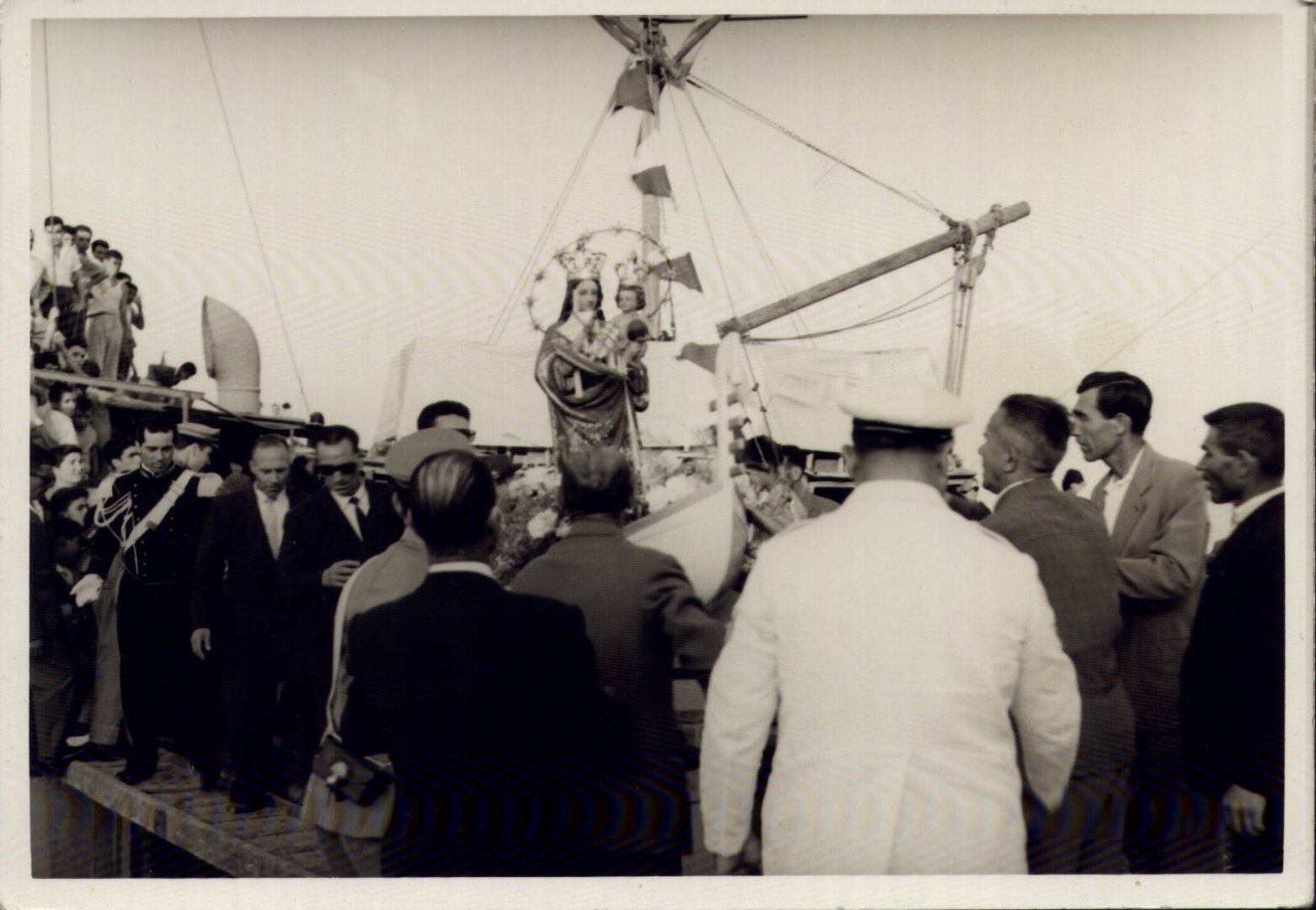
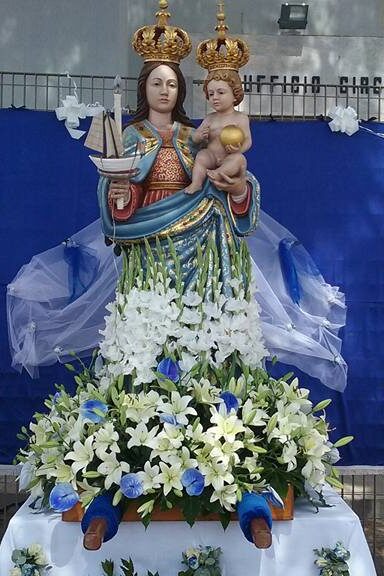
Our Lady of Bonaria is a famous statue of the Madonna and Child, venerated as patron saint of Sardinia e patroness of sailors. According to legend, in 1370 a ship coming from Catalonia was hit by a storm and, to save themselves, the crew threw a heavy chest overboard. The storm subsided and the chest landed on the coast of Cagliari, inside of which the statue was kept. The Mercedarian friars retrieved it and preserved it in the sanctuary of Bonaria, which became one of the most important places of worship on the island.